What Small Studios Should Put in a Game Press Kit, and Why It Matters
What belongs in an indie game press kit? Learn how clear descriptions, usable assets, review instructions, and current facts support accurate coverage.


I get emails from developers asking me to review their games, and I'm usually open to taking a look. I'm a gamer first. I'll try something, add it to my rotation, finish it, or stop halfway through. Finding something unfamiliar is part of the fun.
But when I open what someone calls their press kit, sometimes all I find is screenshots.
I understand how that happens. You're making a game, handling a business, and trying to convince people to pay attention. Putting together press materials can become one more job squeezed into an already ridiculous workload.
Still, screenshots only answer some of the questions someone needs answered before covering your game. They show what it looks like. They don't necessarily explain how it plays, what's available, who made it, or how to get a review build.
A sufficient press kit gives journalists and creators a reliable starting point: clear information, representative assets, and a person to contact. It makes coverage easier to produce and helps your game's identity remain consistent across it.
That deserves the same care you'd give any other part of presenting your business.
A Press Kit Gives People Enough Information to Work With
Think about what happens after your email arrives.
The recipient needs to establish what the game is, whether it suits their audience, whether they have time to cover it, and what they can actually play. If they proceed, they need accurate names, release information, images, and a way to resolve questions.
Your press kit should support that entire process.
Three related materials have different jobs.
- The pitch explains why this particular person might care right now.
- A press release records an announcement, such as a release date or new demo.
- The press kit houses the reusable information and assets that support coverage beyond that announcement.
A press release can live inside the kit. A good screenshot can strengthen the pitch. Neither supplies everything on its own.
This is a practical response to limited time. In its 2026 State of the Media findings, Cision reports that 49% of surveyed journalists identified resource constraints among their biggest challenges.
The survey included more than 1,800 reporters globally. It covers journalism broadly, so that figure shouldn't be presented as a statistic about games reviewers specifically. It does provide context for why avoidable follow-up work matters.
Even the premise behind Rami Ismail's presskit() is rooted in this problem: developers and journalists both need an efficient way to share game information and media. The tool was developed with feedback from journalists and independent developers.
You can meet that need with a modest webpage and an organized folder. Expensive presentation isn't a prerequisite, especially since indies have become a lot more ambitious.
Instead, accessible, accurate material is the mandate.
Explain the Game Before Asking Someone to Describe It
Your description is where you establish what players actually do.
For a hypothetical game, look at this introduction:
An unforgettable dark fantasy adventure with challenging combat, deep progression, and endless replayability.
There's atmosphere there, but very little a writer can confidently explain. Is combat turn-based? Are levels procedural? Does death restart the campaign? What creates the replayability?
Now take a more informative version of that fictional description:
A single-player action RPG in which you explore handcrafted dungeons, switch between three weapon forms during combat, and return to checkpoints after defeat while retaining your equipment and quest progress.
That gives someone a working understanding of the game. You can follow it with the setting, characters, and distinctive ideas.
This matters when appearances suggest mechanics your game doesn't have. A screenshot of a dungeon, an upgrade menu, and a health bar could belong to several genres. If I assume your game is a roguelite and another publication describes a conventional campaign, prospective players now have conflicting expectations.
Genre labels can be contested, especially for hybrids. Explaining the structure gives people something firmer to work with: what resets, what persists, how encounters work, and whether levels are handcrafted or generated. Pair your preferred description with those facts.
Start with a short paragraph that covers the genre, player activity, and distinguishing mechanic. Add a longer overview for the setting and progression, followed by a handful of concrete features.
Each should describe something observable: combining party abilities, negotiating without combat, or exploring without quest markers.
Sabotage Studio's Sea of Stars press kit demonstrates this approach. Alongside its turn-based RPG description, it explains timed hits, combined attacks, and the combat system for disrupting enemy abilities.
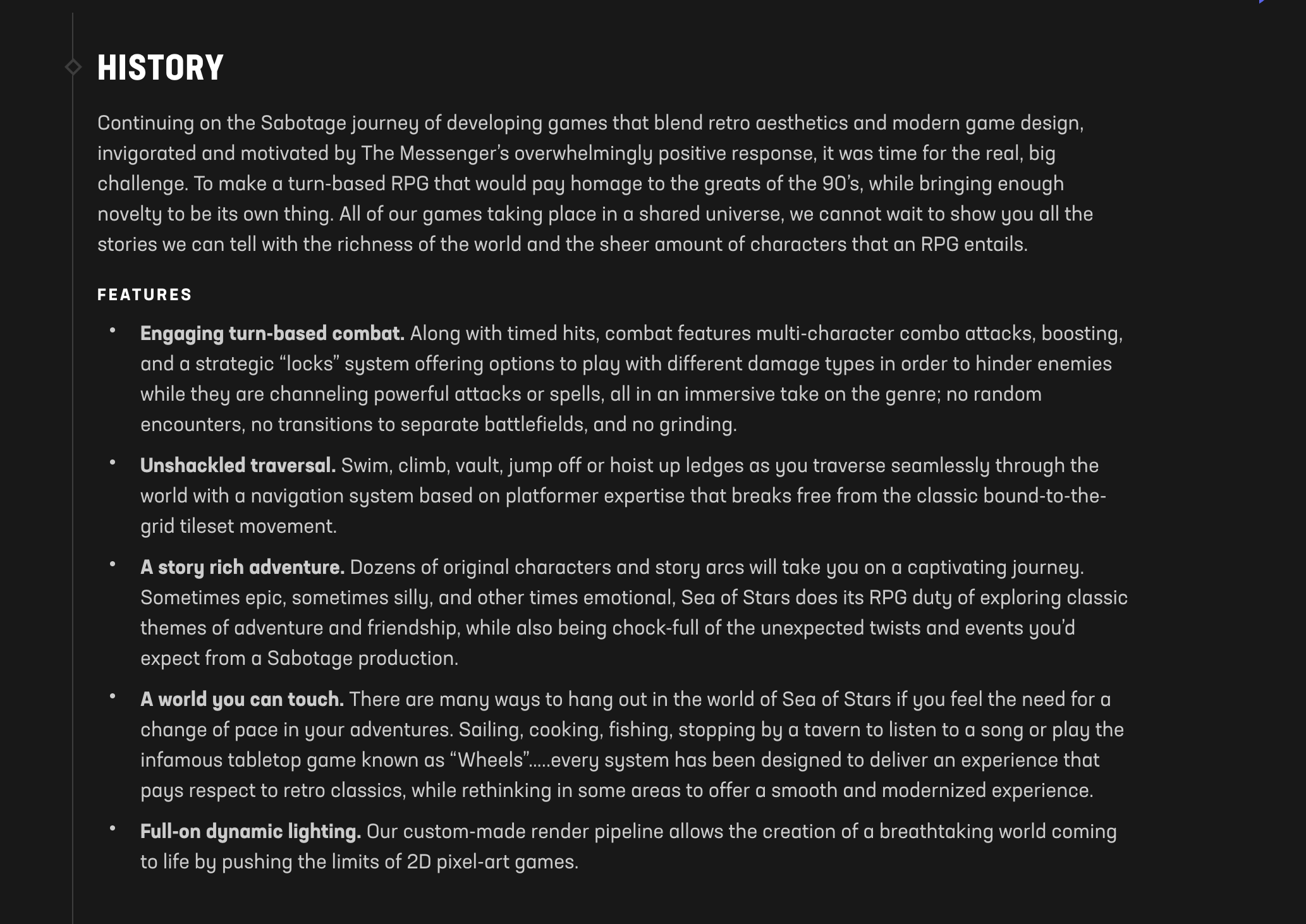
It also separates game facts, artwork, screenshots, videos, and credits. A writer can investigate those specific ideas instead of trying to interpret a string of adjectives.
Your goal is to give coverage a consistent factual foundation. Reviewers will still choose their own comparisons, identify weaknesses, and disagree with your intentions.
That's just a part of independent criticism, but a cohesive press kit helps them understand what they're evaluating at the very least.
Put the Facts Where Nobody Has to Hunt for Them
Keep a scannable fact sheet near the top of the kit. Someone should be able to find the release status or supported platforms without reading your studio's entire history.
The following is a practical starting point. Include confirmed information and mark unresolved details clearly.
| Include | Make it specific |
|---|---|
| Game and studio identity | Official title, developer, publisher or self-published status, and website. |
| Release and availability | Confirmed dates by platform, current development stage, store links, and demo availability. |
| Price and business model | Price with currency and edition; clarify paid DLC, subscriptions, or in-game purchases where applicable. |
| Game structure and modes | Genre, progression, player count, local or online multiplayer, and relevant connection requirements. |
| Languages and accessibility | Separate interface, subtitles, and voice support. List implemented accessibility options. |
| Contacts and currency | Monitored press email, review-copy request route, and the date the information was last updated. |
Be precise where a shorthand could mislead. “Multiplayer” doesn't explain whether friends need separate copies or can share a couch. “Controller support” doesn't tell someone which platforms or inputs you've tested. “Coming to consoles” leaves too much room for inference.
If a feature is planned, label it as planned. If the price is unannounced, say so. Separate Early Access availability from the full release and distinguish the base game from an expansion.
Accessibility deserves the same specificity. Describe the options you have implemented, such as remappable controls, adjustable text, or alternatives to timed inputs. Someone can then assess whether those options address their needs.
Give Editors Assets They Can Actually Publish
Screenshots are valuable, obviously. The problem is expecting them to do every other job in the kit.
Curate a set that shows the experience from several angles: ordinary gameplay, combat or another central interaction, exploration, and a representative interface.
Include quieter moments if they are important to the game. A folder full of scenery can leave readers with little understanding of how they'll spend their time.
I would start with six to ten distinct images, then add more when they show something meaningfully different. That's a practical recommendation, not an industry requirement.
Provide downloadable original files. Embedding a picture in a document is useful for previewing it, but the editor should also have the image itself.
Preserve the game's actual aspect ratio and use clean, high-resolution captures where available. Enlarging a small image doesn't recover detail.
Label images with descriptive filenames, such as game-title-party-combat-01.png. A short caption can identify the location, mechanic, platform, and build. Mark concept art, staged promotional images, and early development captures accordingly.
The rest of the visual package should include:
- Game and studio logos: Separate files with transparent backgrounds, plus light and dark versions if needed for legibility.
- Key art: A high-resolution illustration or promotional composition, ideally with versions both with and without the title treatment.
- Trailer: A viewing link and a downloadable file suitable for editorial use.
- Gameplay footage: A representative sequence that shows how the game plays, with the build or platform identified where relevant.
- Asset notes: Credits, descriptions, and clear information about permitted editorial use and any restrictions.
Fika Productions makes the viewing-versus-downloading distinction explicit in its press kit: its trailers have YouTube links and separate downloads, while screenshots and logos have their own downloadable archives.
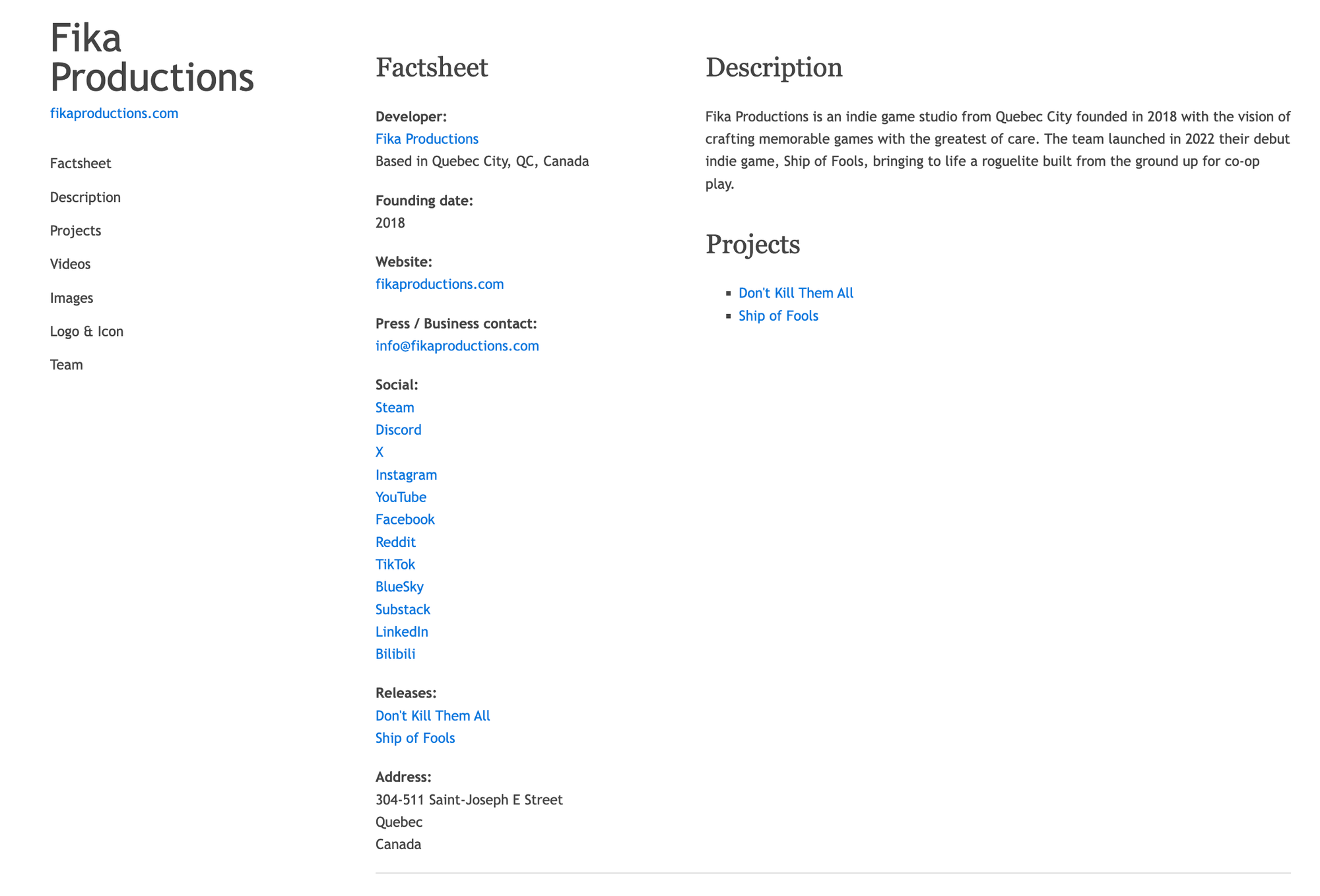
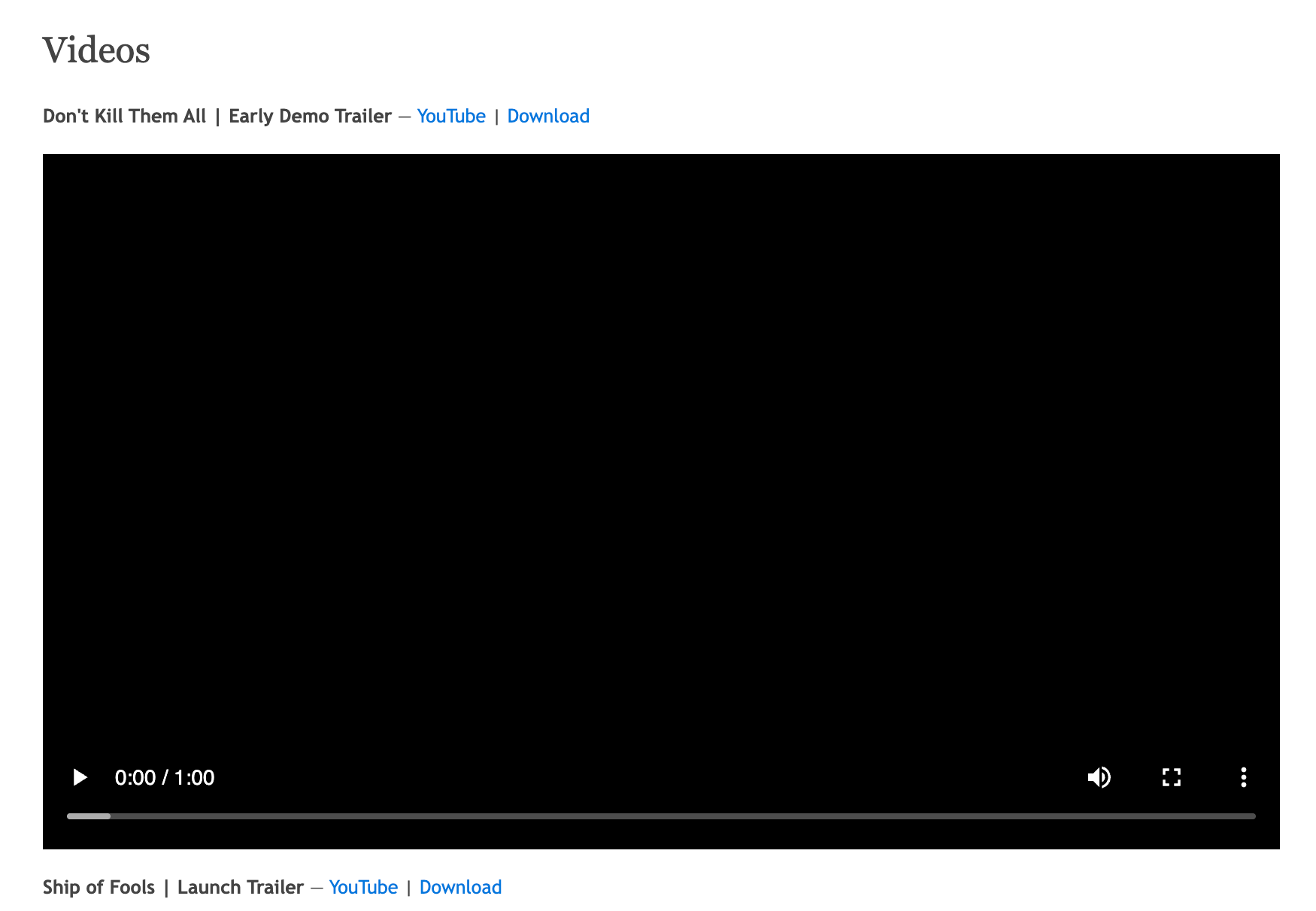
Those options serve different needs. Someone deciding whether to cover a game may watch the trailer; someone editing a video needs a usable file.
Keep spoiler-heavy assets in a clearly marked section. Give people a useful default selection they can publish without accidentally revealing your final boss.
Brand cohesion also benefits from this preparation. The correct logo, consistent title spelling, and recognizable artwork make it easier for readers to connect coverage with your store page. Keep any usage guidance short and practical.
Editors need to know which files to use and how to credit them, without working through a presentation about your brand philosophy.
Include the People and Decisions Behind the Game
A fact sheet helps someone report the basics. Background can help them find a feature angle.
Include a brief studio introduction and identify the people responsible for the work.
Credit collaborators accurately, including freelance artists, composers, localization teams, and other contributors where applicable. Explain the publisher's role separately from development.
Then give the reader a few specific reasons the project exists in its current form. Perhaps the battle system grew from an abandoned prototype. Perhaps a local tradition informed the setting. Perhaps the composer developed the music around the player's changing choices.
Explain what happened and why it matters to the game. If you have a relevant development video, interview, or comparison image, link to it.
Avoid inflating the story to make it sound more impressive. A small team's precise explanation of one design decision can be much more useful than broad claims about redefining a genre.
If you list an award, identify the awarding organization, year, category, and whether you won or were nominated.
This section also has a business function. Festival organizers, potential collaborators, and other industry contacts can use the same verified background to understand your studio. Your press kit won't answer every commercial question, but it establishes who you are and how to reach you.
Keep Review Access Separate From Public Assets
A public kit should explain how to request access. Individual keys, private builds, and confidential instructions belong in a separate communication or restricted resource.
When you provide a review copy, include enough information to prevent avoidable confusion:
- The platform, build version, installation instructions, and any required access steps.
- Whether this is a preview build, demo, Early Access version, or intended review version.
- Significant known issues, unavailable features, and confirmed changes still expected before release.
- Any access expiration, server schedule, or multiplayer testing arrangements.
- An estimated playtime range with context, such as the main story versus optional content.
- A direct contact for technical problems and factual questions.
A reviewer needs to know whether an unavailable feature is absent from the game or simply absent from that build. Likewise, a planned fix should be described as planned until it has been verified. That lets the reviewer explain the version they actually experienced.
If you propose an embargo, put its terms upfront and obtain agreement before sharing embargoed material. Specify the full date, time, and time zone, along with whether it covers reviews, streaming, screenshots, or particular information.
“Embargo lifts Friday” is insufficient for people working across countries.
Make content-creation permissions easy to find, too. Clarify what your studio permits for gameplay video and streaming, including monetization where relevant. Identify known third-party music restrictions instead of making promises beyond the rights you control.
The materials should help someone evaluate the game on an informed basis. Providing access doesn't guarantee coverage, a favorable score, or approval of the article before publication.
Organize the Kit Around the Person Opening It
Give the kit one stable address and link to it from your website and pitch. A simple webpage can hold the text and previews, with downloadable assets organized underneath it.
A shared folder can also work. Include a clearly named starting document and make the public materials readable and downloadable without an access request. Check that using a signed-out browser before sending the link.
A straightforward folder structure might contain:
- Start Here: Fact sheet, descriptions, official links, press contact, and last-updated date.
- Screenshots: Representative captures with a caption and credit list.
- Logos and Key Art: Separate game and studio assets with brief usage notes.
- Video: Trailers, gameplay footage, and corresponding viewing links.
- Studio and Credits: Background, relevant development stories, and contributor information.
- Announcements: Dated press releases, with the current announcement identified.
Offer individual downloads alongside a complete archive when feasible. Someone looking for a logo shouldn't need to download several gigabytes of footage first.
Keep the written information selectable and searchable. A visually attractive PDF can be a useful companion, but image-only text makes names, prices, and dates harder to reuse accurately.
Tools such as Pixelnest's presskit.html provide a game-focused structure covering descriptions, release information, media, credits, and contacts.
You can also use your existing website. Choose something your team can maintain without turning every correction into a separate development project.
Treat Maintenance as Part of the Kit
Assign one person responsibility for its accuracy, even if several people contribute assets. Update it when release plans, pricing, platform support, features, or contacts change.
Check the store page, current announcement, fact sheet, and review instructions together. If they disagree, a journalist has to decide which one to trust or send another email.
Move outdated media out of the default selection. It can remain available as clearly dated development history, but an editor looking for current screenshots shouldn't have to guess which interface survived production.
Before sending a pitch, ask someone unfamiliar with the project to use the kit. Can they explain what players do? Find the release status? Download an image and its credit? Identify how to request a copy?
Their questions reveal the gaps. After outreach begins, record the factual questions you repeatedly receive and use them to improve the kit.
You don't need to measure success solely through coverage volume, which also depends on audience fit, timing, editorial capacity, and the game itself. Fewer repeated questions and fewer avoidable factual corrections are useful signs that the materials are doing their job.
At the end of the day, I want developers to send me their games. I want to discover something worth playing and help readers understand why it caught my attention.
A comprehensive press kit makes that work easier. It gives your game a clear introduction, your collaborators accurate credit, and your studio a professional way to handle interest.
Start with the facts and assets someone actually needs, keep them current, and give the person covering your game enough information to do it justice.